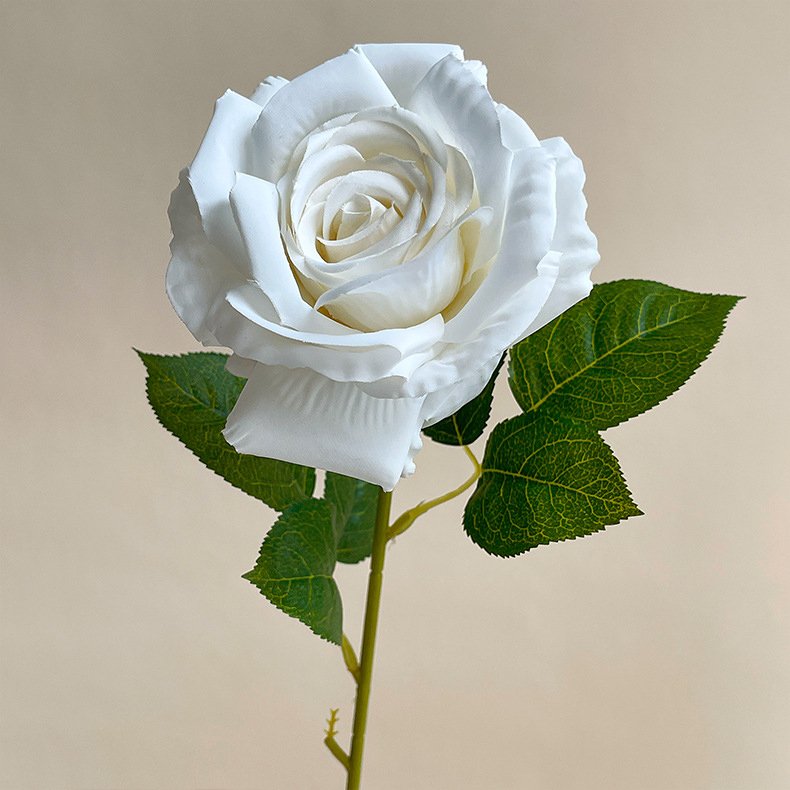
“Silk”, “real touch”, “PU”, “EVA”, “PVC”: artificial flower listings use these words as if everyone already knows what they mean. Most buyers don’t, and the labels are not regulated. This guide explains what each material actually is, what it costs per stem in NB8 Floral’s catalogue, and the questions that matter more than the label: sunlight, heat, fire rules at venues, chemical rules, allergies and what happens at the end of a flower’s life.
We are NB8 Floral, an artificial flower manufacturer, so we have an interest here. We have tried to keep every factual claim tied to a source you can check, and to say clearly where the evidence runs out. The sources are listed at the end.
The Short Answer
Choose by where the flower will be seen, not by the label. Close-up pieces such as bouquets and head tables are where softer “real touch” petals earn their price. Arches, backdrops and high shelves rarely need them.
Material is a smaller price lever than most buyers think. In NB8 Floral’s catalogue, real touch stems cost about 16% more than silk at the median ($2.82 against $2.43).[1]
For venues, fire safety matters more than material. The model fire code requires artificial decorative vegetation to meet NFPA 701, certified by the manufacturer.[12] Ask for the certificate before you buy.
For windows and hot vehicles, heat and UV matter. Some EVA grades start to soften at around 45–61 °C,[8] and a closed car can reach 47 °C even on a mild day.[10]
Labels are not standardised. No standards body defines “real touch”, and US fiber-labelling rules do not cover artificial flowers. Ask what a stem is made of, in writing.
What the Material Names Actually Mean
“Silk” usually means polyester
Very few “silk flowers” are made of silk. When US Customs classified a typical shipment of “silk-style” flowers for a large craft retailer, it described them as “polyester flower heads and leaves, plastic and iron wire stems”.[2] Polyester became the standard because it is cheaper, takes dye and glue well, and lasts; real silk, rayon and cotton are kept for upscale work.[3] Even florists’ trade press puts the word in quotation marks.[17]
One practical consequence: the US Textile Act’s labelling rules cover a fixed list of products such as clothing and bedding, and artificial flowers are not on that list.[4] So a “silk” flower in the US does not need a fiber-content label. If fiber content matters to you, ask the supplier and get the answer in writing.
“Real touch” is a marketing term, not a material
“Real touch” describes a feel: a soft, slightly damp-feeling petal with some give. Suppliers use it for several different constructions, including polyurethane (PU) films and foams and latex-type coatings. No standards body or government agency defines the term. Polyurethane itself is a family of polymers made by reacting a polyol with a diisocyanate, and it can be produced as foams, films or coatings.[5] Latex-coated decorative flowers are not a myth either: US Customs rulings from the 1990s describe artificial flowers of “paper coated with latex rubber”.[6]
In NB8 Floral’s own catalogue, both constructions are sold as real touch: some stems have PU petals, others have a latex coating. If that difference matters for your event, ask us which construction a specific stem uses before you order.
PU, EVA, PE, PVC, foam and flocking
PU (polyurethane): often used for soft, thick petals and leaves, and for greenery that should feel natural.
EVA foam: soft, light and inexpensive. Its weakness is heat: ExxonMobil’s EVA resin datasheets list softening points of 45 °C and 61 °C for two common grades.[8]
PE (polyethylene) and other plastics: common for leaves, greenery and stems. Low-density polyethylene softens at a much higher temperature, around 89–91 °C in ExxonMobil’s datasheets.[9] Outdoor use depends on UV stabilisers: one study found that adding 0.2% UV stabiliser extended the life of LDPE film by about four to five times.[11]
PVC: rigid PVC becomes flexible when plasticisers are added, and some of these are phthalates, which are regulated (see below).[15]
Foam: in NB8 Floral’s catalogue, mostly large fruit and pomegranate heads.
Flocking: a velvety surface made by attaching short fibres to a petal or leaf.
Material also affects import duty. The US tariff schedule splits artificial flowers by material: 3.4% or 8.4% for plastics, 9% for man-made fibres such as polyester, and 17% for “other” materials, which includes real silk.[7] These are the general rates only; additional tariffs on goods from China are not included.
What Each Material Costs Per Stem
These are median list prices per stem in NB8 Floral’s own catalogue, read on 21 September 2026, before freight and duty.[1] They are one supplier’s prices, not a market survey.
Material
SKUs
Price points
Median per stem
Typical range (p10–p90)
Foam*
9
22
$3.74
$2.65–$4.99
PVC*
12
27
$2.89
$2.29–$3.91
Real touch
66
442
$2.82
$1.64–$4.40
Flocking*
9
43
$2.47
$1.13–$3.42
Silk (polyester)
216
1,441
$2.43
$1.40–$3.55
PU
33
219
$2.36
$1.41–$3.62
Plastic
13
56
$2.07
$1.68–$2.86
3D silk*
9
99
$2.04
$0.62–$4.07
EVA*
6
34
$1.50
$0.98–$2.06
* Fewer than 15 SKUs, so treat these medians as a rough guide. Foam is the most expensive mainly because our foam items are bulky fruit heads that pack few to a carton, not because foam is a premium material.
Two things matter more for price than material. First, the flower: a median hydrangea stem costs $3.06 and a median tulip stem $1.74.[24] Second, the carton: in the same data, cartons of 25 stems or fewer cost $3.36 per stem at the median, against $1.64 for cartons of more than 60.[1] For a more detailed comparison of the three most common materials, see real touch vs silk vs PU.
Realism: Viewing Distance Decides
Every material can look convincing from across a room. The differences show up at arm’s length and when people touch the flowers. That is why we suggest spending on real touch for bouquets, boutonnieres, head tables and counter displays, and using silk or PU for arches, backdrops, ceiling installations and high shelves. We explain this rule scene by scene in artificial flower quality levels.
Sunlight and Fading
Sunlight fades dyed fabrics and breaks down plastics over time. A UN Environment Programme assessment calls the damaging effects of solar UV on plastics “well documented”.[14] Stabilisers slow the process but do not stop it.
If you need flowers for a sunny window, a patio or a storefront, ask the supplier for test results under a recognised method:
For fabric petals: AATCC TM16.3 (US) or ISO 105-B02 (international), both xenon-arc lightfastness tests.[13]
For plastic parts: ASTM G154 or ASTM D4329 UV exposure, with the hours and conditions stated.[13]
Be careful with claims like “UV-resistant for three years”. AATCC states that the relationship between a lab test and real exposure “must be determined and agreed upon by the contractual parties”.[13] In other words, lab hours do not translate directly into years outdoors. We are running our own side-by-side window test of fresh and faux flowers and will publish the results here.
Heat: Windows and Delivery Vans
Researchers measuring parked cars found that interiors reached 117 °F (47 °C) even on the coolest day they tested, and earlier studies they cite recorded 134–154 °F (57–68 °C).[10] Some EVA resins start to soften at 45–61 °C.[8] These figures come from resin datasheets, not from tests on finished flowers, but the practical lesson is clear: don’t leave foam or EVA pieces in a closed car or van in the sun, and set them up last on hot event days. PE parts have more margin. We could not find reliable heat data for the PU used in artificial flowers, so we don’t quote a number for it.
Fire Safety at Venues
This is the question event planners most often learn about too late. The 2021 International Fire Code states that “artificial decorative vegetation shall meet the flame propagation performance criteria” of NFPA 701, and that this “shall be documented and certified by the manufacturer”.[12] NFPA 701 is the standard test for flame propagation of textiles and films.[12] Large foam décor in assembly venues has its own heat-release limit, with an exemption for single foam items under 1 lb (0.45 kg).[12]
Local fire departments apply this in practice. Clark County, Nevada (Las Vegas) asks for “a certificate of flame resistance” for decorative items with the event plan.[19] Prince William County, Virginia asks for “NFPA 701 Flame Spread Certification for all artificial vegetation”.[20] In California, the State Fire Marshal’s flame-retardant program covers “other decorative materials such as artificial plants”,[18] so venues may want a California-registered certificate.
Rules vary by jurisdiction and fire-code edition, so check with the venue and the local fire marshal before you buy. Flame-retardant treatments also need to stay effective in use,[12] so ask how long a certificate remains valid.
To be clear about our own position: NB8 Floral does not currently hold NFPA 701 or California State Fire Marshal certificates for its flowers. If your venue or fire marshal requires certified décor, our stems are not the right choice for that installation, and you should buy items that come with the certificate.
Chemicals: Phthalates in Soft Plastics
Phthalates are “added to some plastics to make them flexible”.[15] One of them, DEHP, is on California’s Proposition 65 list because it can cause cancer and reproductive harm, and California’s official guidance suggests avoiding PVC (recycling code 3).[15] Under Proposition 65, a warning must be given for listed chemicals unless exposure is low enough to pose no significant risk.[15]
In the European Union, since 7 July 2020, articles may not contain 0.1% or more of four phthalates (DEHP, DBP, BBP and DIBP) in any plasticised material. The rule explicitly includes PVC, polyurethanes and polymer foams, not just toys.[16] If you sell soft-plastic décor into California or the EU, ask your supplier for a phthalate test report.
Latex Allergy
Latex allergy is a reaction to proteins found in natural rubber latex, which comes from the sap of rubber trees.[21] A review estimated that it affects about 4.3% of the general population and 9.7% of healthcare workers.[22] According to the American Academy of Allergy, Asthma & Immunology, “synthetic products … have not been shown to pose any hazard to latex-sensitive individuals”, although other chemicals in a product can still cause skin irritation.[21]
So the useful question for hospitals, care homes or children’s events is not “is it latex?” but “does it contain natural rubber latex?”. Because some real touch stems, including some of ours, are latex-coated, choose silk or PU stems for latex-sensitive settings, and ask the supplier which construction each stem uses. The US FDA advises against calling medical products “latex-free” because that cannot be reliably assured; it recommends “not made with natural rubber latex” instead.[23] We follow the same wording, and only when the supplier can document it.
Cleaning
We found no independent guidance written specifically for artificial flowers. The most credible general advice is simple: wipe dust regularly with a damp cloth, which California recommends as a way to reduce exposure to plastic additives in household dust,[15] and test any cleaning method on a hidden spot first, as museum textile conservators do.[25] Whether a particular stem can be rinsed depends on its dyes and coatings, so test before you wash.
The Honest Sustainability Picture
Artificial flowers are a mix of polyester, plastic, wire and glue, and in practice they are not recyclable at the curb. Even single-material streams recycle poorly in the US: 14.7% for textiles and 8.7% for plastics in 2018.[26] Polyester also sheds microfibres, especially through abrasion; one study found abrasion produced 5 to 30 times more microfibres than were present on unworn fabric.[27]
Fresh flowers have a footprint too. A Cranfield University study for the UK market found that 12,000 Kenyan roses emitted about 2,200 kg of CO2, against about 35,000 kg for the same number from a heated Dutch greenhouse.[28] A life cycle assessment for Fairtrade found air freight from overseas emits four to six times less than heating Dutch greenhouses.[29] That footprint repeats with every event.
The fair case for artificial flowers rests on reuse: a stem’s one-time footprint is spread across every event it serves. We could not find a study comparing artificial and fresh flowers per use, so we won’t claim a break-even number. If you choose artificial for environmental reasons, the most important thing you can do is reuse the stems for as long as possible.
Questions to Ask Any Supplier
What exactly are the petals, leaves and stems made of? Please put it in writing.
For “real touch”: is the coating PU, synthetic latex or natural rubber latex?
Can you provide an NFPA 701 certificate, or a California State Fire Marshal registration, for this item?
For window or outdoor use: which lightfastness or UV test was used, for how many hours, under what conditions?
For PVC or soft plastic parts: do you have a phthalate test report?
What is the price per stem, and how many stems are in a carton?
Can I see a sample before ordering in volume? (Our Sample Box mixes silk, PU and real touch stems in one color.)
The Limits of This Guide
Our price data comes from NB8 Floral’s own catalogue. The heat figures come from resin datasheets, not finished flowers. Fire and chemical rules differ by place and change over time, and nothing here is legal advice. Where we could not find a reliable source, we have said so rather than filling the gap.
Frequently Asked Questions
Which artificial flower material costs the most?
In our own catalogue, foam is the most expensive at a median of $3.74 per stem, ahead of PVC at $2.89 and real touch at $2.82. Silk sits at $2.43 and plastic at $2.07. The ranking is driven more by head size and how densely a stem packs into a carton than by the material being inherently premium — foam stems in our range are mostly large fruit and seedhead forms.
Is real touch worth paying more for?
Across our catalogue real touch runs about 16% above silk at the median, not the two or three times that marketing language often implies. It is worth the difference for anything held or inspected at close range, such as bouquets and personal flowers. Beyond arm’s length the same money buys more stems, and density does more for the result than surface texture.
Do venues require flame-retardant artificial flowers?
Many do, and it is the requirement event planners most often discover too late. The 2021 International Fire Code requires artificial decorative vegetation to meet the flame propagation criteria of NFPA 701, documented and certified by the manufacturer. Ask for that certification in writing before an installation in an assembly venue rather than after.
Do artificial flowers contain phthalates?
Some soft plastics do. Phthalates are added to make plastic flexible, and DEHP is on California’s Proposition 65 list. The EU has restricted four phthalates at or above 0.1% in articles since 7 July 2020. Rather than assume, ask a supplier which polymer a stem uses and whether it has been tested against the regulation that applies where you are selling.
Which material looks most realistic?
Viewing distance decides it more than material does. At arm’s length, coated surfaces such as real touch and PU read better because they scatter light the way a petal does. Beyond about three metres nobody can tell the materials apart, and density and colour carry the whole effect. Species matters too: densely petalled flowers hide manufacturing seams in a way smooth, few-petalled flowers cannot.
Yang Yue is the founder of NB8 Floral in Yiwu, Zhejiang, working with US florists and event planners who source artificial flowers. The per-stem figures in this analysis were compiled from the company's own published catalogue, with the method and its limits set out in the article above.
NB8 Floral supplies wholesale artificial flowers to florists, event professionals, and retailers in the US. Our guides are written from what we see in production, QC, and customer orders.
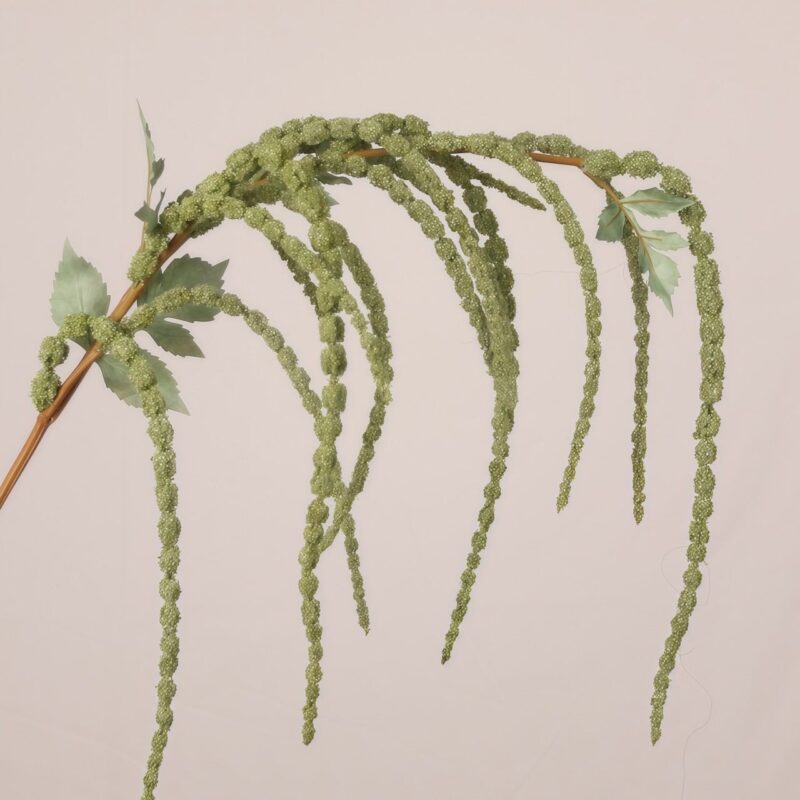
Most arrangements fail in the same direction: everything points up and out, nothing falls down. The fix is a trailing stem, and amaranthus — love-lies-bleeding, in its older name — is the one florists
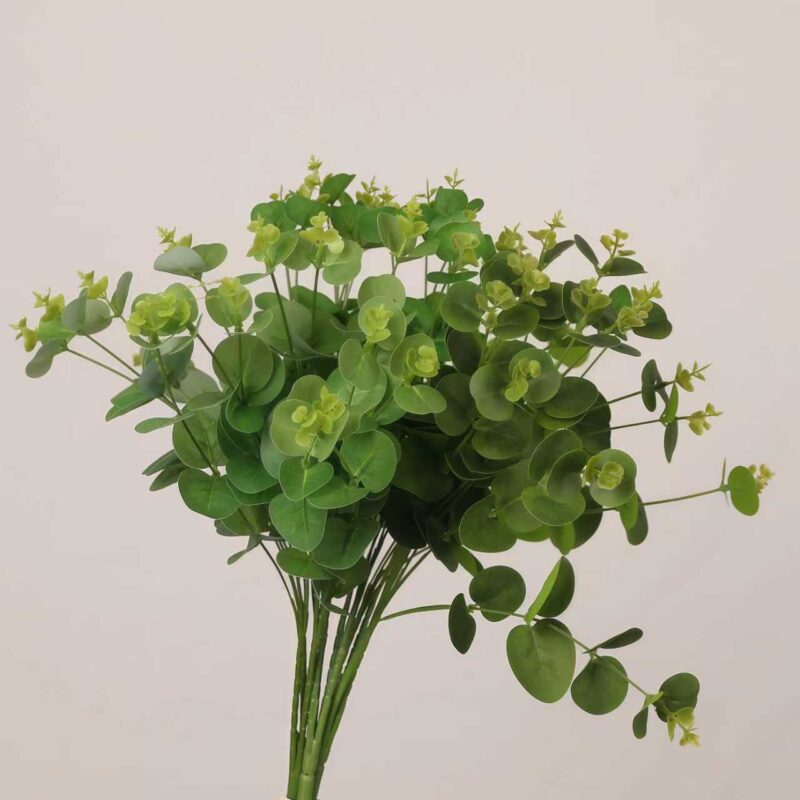
Eucalyptus is the greenery people reach for first, and it is also the one that survives the move to artificial best. Both facts come from the same place: a eucalyptus leaf is matte, slightly irregular
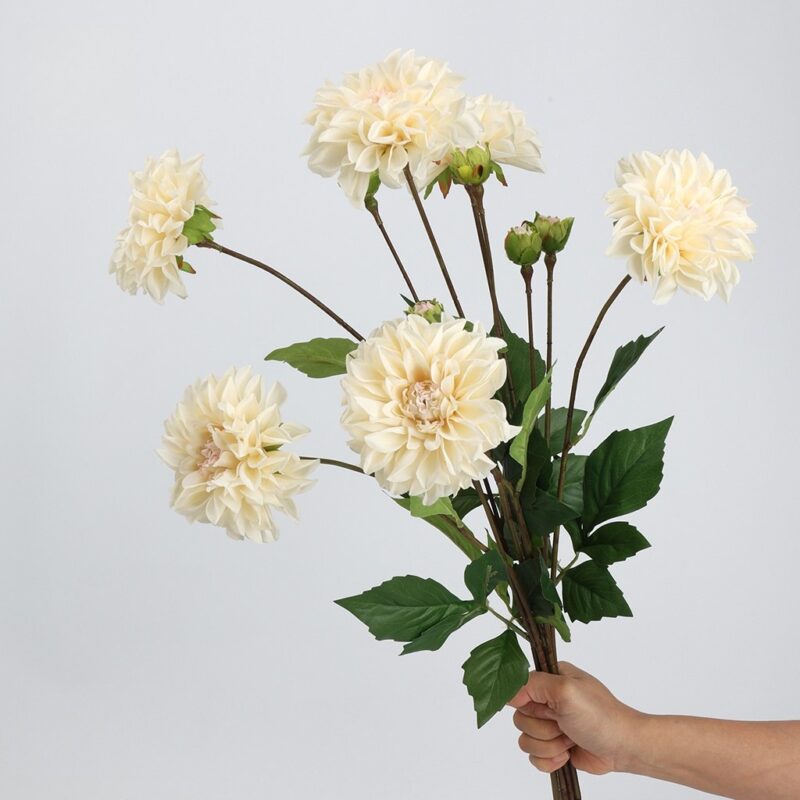
Dahlia is the flower that exposes how an artificial bloom was made, because its whole structure is petal tips and there is nowhere for a shortcut to hide.
Lilies and calla lilies sit in the same collection on most sites, including ours, and that grouping hides the fact that they do opposite things in an arrangement.
Most wedding flower budget advice is a single percentage — flowers are "about 8 to 10 percent of the total," a planning rule of thumb that has been repeated for decades. It is a fine starting point an
The arithmetic that starts most DIY plans is simple: the florist quoted $4,200, the stems cost $900, so DIY wedding flowers save $3,300. That number is wrong in both directions, and the gap between it
A palette chosen on a laptop screen in a bright room has almost nothing to do with how those flowers will look at 7pm in the room where the wedding actually happens. This is the most common and least
This is not about how long flowers last outdoors over a season. It is about a single afternoon — the six hours between install and the last dance, which is the only window that matters for outdoor wed
You picked the flower before you picked the date, and now the quote has come back at three times what you expected — or the answer is simply that nobody can get it that month. Wedding flowers out of s
Every wedding budget spreadsheet eventually arrives at the same idea: build the flowers once, use them twice. The ceremony arch becomes the head table garland, the aisle markers move to cocktail table
Be the first to know about new arrivals, special offers and early sale access. New here? Stretch the possibilities. Get 20% off your first online order of full-priced items when you sign up. Exclusions apply.