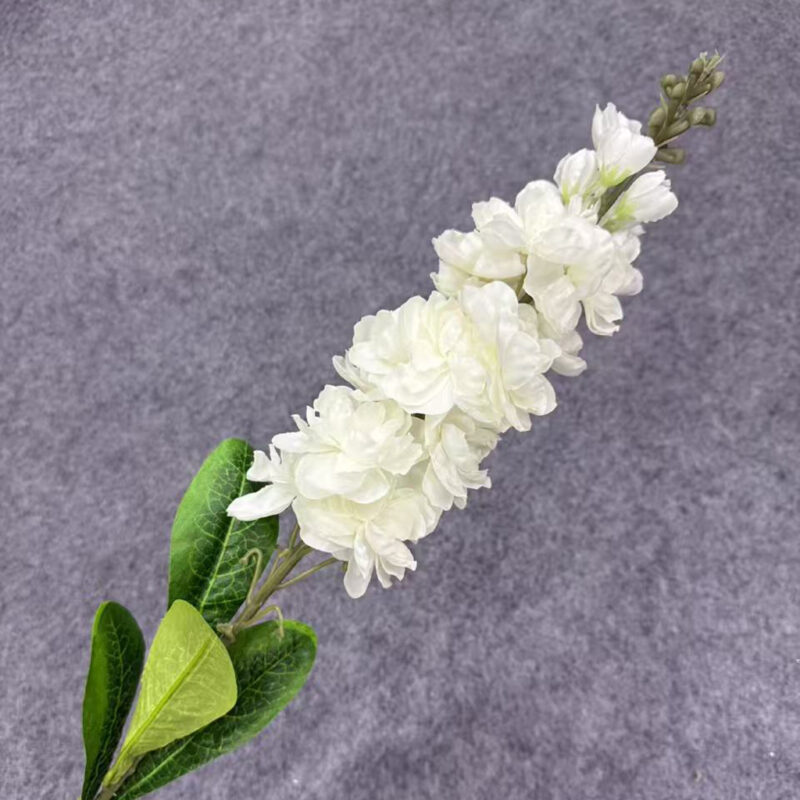
Almost every arrangement that looks wrong looks wrong for the same reason: nobody chose the filler flowers. The focal blooms were picked carefully — the roses, the peonies — and everything between them was an afterthought. The result has expensive blooms sitting in visible gaps, and no amount of adding more roses fixes it, because the problem is not volume. It is the absence of anything smaller.
This is what filler flowers do. They are the stems nobody photographs on their own and everybody notices when they are missing.
Filler, Texture, and Line: Three Different Jobs
“Filler” gets used for everything that is not a focal flower, which hides a distinction worth keeping.
Role
What it does
Typical stems
Volume filler
Occupies space cheaply so focal blooms do not have to
Hydrangea, pompon ball, baby’s breath
Texture filler
Breaks up smooth petal surfaces with something fine or matte
Scabiosa, cosmos, freesia, sweet pea
Line material
Sets the outline and height of the arrangement
Delphinium, agapanthus, crape myrtle
Most arrangements need all three, and the mistake is usually to buy one of them in three colours rather than three of them in one colour.
Volume Filler: Buy It by the Head, Not the Stem
A hydrangea head is a dome of dozens of small florets, so a single stem fills more space than a single-bloom flower of the same price. That makes artificial hydrangeas the standard way to build base volume before focal flowers go in.
Pompon balls do the same work in a smaller, tighter form, which suits compact table arrangements where a hydrangea head would be too wide. Baby’s breath sprays fill differently again — they add a cloud rather than a mass, which is why they read as light and why they are the wrong choice when you need to hide a mechanic like exposed foam.
A rough working order: volume filler first, focal flowers second, texture last. If you add texture before volume, you end up pulling it back out.
Texture Filler: The Part Buyers Skip and Then Miss
Texture stems are small-headed and usually multi-headed, and their job is contrast. Rose and peony petals are broad and smooth; put six of them together and the eye has nothing to catch on.
The ones worth knowing from our range:
Scabiosa — a domed pincushion head with visible individual florets. Strong texture in a small footprint.
Cosmos — flat open faces on thin stems. Reads casual and garden-grown, not formal.
Sweet pea — ruffled, slightly translucent petals on a soft stem. The most “fresh-picked” texture in the catalogue.
Freesia — a small trumpet spray that adds both texture and a little height.
Crape myrtle — crinkled clustered florets on a woody stem, useful where you want texture with some structure.
Corn poppy — a thin wiry stem with a single papery bloom. Adds movement rather than mass.
These are in the assorted florals collection, which is where flower types without a collection of their own live, alongside carnation, gardenia, lisianthus, marigold, zinnia, camellia, bluebell, iris, protea and others.
Line Material: Set the Outline Before You Fill It
Line flowers decide the shape of the arrangement, so they go in early even though they are not the point of it. A delphinium spike sets height at the back of a centerpiece; agapanthus does a similar job with a rounder head; crape myrtle gives a shorter, woodier line.
There is no universal ratio, but the working proportion most designers land on is roughly one third focal, one third volume filler, one third texture and line, counted in stems rather than in cost. Focal flowers are more expensive, so that split usually means filler is a small share of the budget and a large share of the stem count.
Our how many stems for a vase guide works through this by vase size, including how deep the stems sit and how much shows above the rim.
What to Check Before Buying Filler in Bulk
Filler flowers get judged less carefully than focal blooms, which is exactly why quality problems hide in them.
Head count per stem, not stem count. A “3 heads” scabiosa and a “5 heads” cosmos fill very differently. Our product pages list the head count in the title where the SKU has one.
Whether the wire is in every branch or only the main stem. Texture filler is usually fanned open by hand; if only the central stem is wired, the side branches will not hold the position you set.
Matte vs shiny at arm’s length. Fine-petalled flowers show sheen more than broad ones, because there is more edge per square inch. Real-touch and flocked finishes read matte; woven silk can read shiny under warm light. See real touch vs silk vs PU.
Pack size against your actual need. Filler in our range runs from 15 PCS to 100 PCS per carton. Buying the 100 PCS carton of a texture stem you use three of per arrangement is how stock rooms fill up.
Filler Is Where Faux Has the Clearest Advantage
One practical note. Fresh filler is the first thing to wilt in an arrangement — fine petals and thin stems dry out before a rose head does. In a fresh arrangement that puts a clock on the whole piece, because the filler fails while the focal flowers still look fine.
Faux filler removes that asymmetry, which is why mixed arrangements often use fresh focal flowers and faux filler. It is also why filler is a sensible first faux purchase for a venue or a shop testing the category: low cost per stem, high reuse, and the part of the arrangement guests are least likely to inspect closely.
FAQ
What are filler flowers?
Filler flowers are the smaller stems placed between focal blooms to occupy space, add texture, and set the outline of an arrangement. Common examples are hydrangea and pompon ball for volume, scabiosa and cosmos for texture, and delphinium or agapanthus for vertical line.
How many filler stems do I need?
As a starting proportion, roughly two thirds of the stem count in an arrangement is filler and line material, with one third focal flowers. Count stems, not spend — filler is usually a small part of the budget.
Which artificial filler flowers look most realistic?
Fine-petalled flowers show surface sheen more than broad-petalled ones, so matte finishes matter more in filler than in focal blooms. Real-touch and flocked stems read matte; check the finish at arm’s length under the lighting the arrangement will actually sit in.
Can I mix artificial filler with fresh focal flowers?
Yes, and it is a common combination, because fresh filler wilts before fresh focal flowers do. Using faux filler removes the weakest part of a fresh arrangement’s lifespan.
NB8 Floral supplies wholesale artificial flowers to florists, event professionals, and retailers in the US. Our guides are written from what we see in production, QC, and customer orders.
Baby's breath is the most-used filler in wedding floristry and the one with the most annoying failure mode. The faux version is one of the few substitutions that is a straight upgrade.
Lilies and calla lilies sit in the same collection on most sites, including ours, and that grouping hides the fact that they do opposite things in an arrangement.