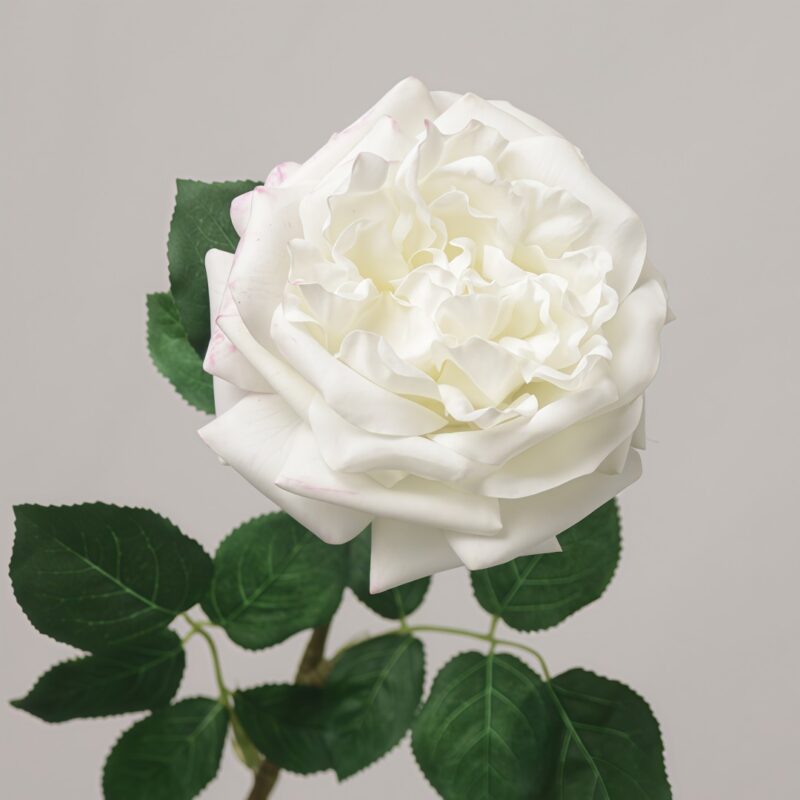
Most focal flowers work by having more petals: a rose, a peony, a dahlia. An artificial protea works a different way — it is focal because of surface texture, not petal count, and the same is true of pincushion.
That changes two practical things: which materials suit them, and how many you need. The answer to the second one is usually “fewer than you think.”
Two Different Shapes, One Family
Both belong to the Proteaceae, and in an arrangement they play related but distinct roles.
King protea is a large single head: a wide bowl of stiff pointed bracts around a dense fuzzy centre. It is the biggest single object in most arrangements it appears in, and it reads as deliberate and slightly architectural. One stem is a focal point; two compete.
Pincushion (leucospermum) is a sphere of fine tubular florets radiating outward, each tipped with a small knob — hence the name. It reads as a texture ball rather than as a bloom, and unlike protea it works in small groups.
Why Flocking Suits an Artificial Protea, and PU Suits Pincushion
This is a case where the material choice follows directly from the flower’s structure rather than from budget.
An artificial protea’s centre has to be fuzzy. That is its defining feature, and a woven fabric cannot reproduce it — fabric reads as fabric on a surface that large. A flocked finish, which applies short fibres to the surface, is the technique that gets it right. Our King protea is flocked for exactly that reason.
A pincushion is dozens of smooth tubular florets. Each floret is a small smooth rod with a knob on the end, and it needs to hold a straight radiating line. PU handles this: it holds the moulded shape and takes a slight sheen that reads as the waxy surface of the real florets. Fabric florets droop and lose the sphere.
The general principle — match the finish to what the flower’s surface actually is — is set out in our materials guide, and the same logic decides tulips and anthurium.
Using One Stem as a Whole Design
Because a protea head is large and visually heavy, the arrangement usually gets built around it rather than including it:
Place the protea first, slightly off-centre and angled rather than facing straight out. A protea facing the viewer dead-on looks like a specimen; angled, it looks placed.
Add structure, not flowers. Greenery, eucalyptus, grasses, seedheads. Anything with petals near a protea competes with it.
Keep the count odd and low. One protea with three pincushions and greenery is a complete design. Adding roses to that usually makes it worse, not fuller.
For pincushions used without protea, three in a triangle with texture filler between them is the standard arrangement, and our filler flowers guide covers what goes in the gaps.
Where These Get Specified
Boho and modern-rustic weddings — the shapes that defined that look, alongside dried grasses and eucalyptus.
Tropical and resort interiors — protea reads tropical without being a hibiscus cliché.
Autumn schemes — the orange and red pincushion colourways sit naturally with berries and dahlias, and our berries and seedheads guide covers the rest of that palette.
Retail display — one protea holds a window from across a street, which is a specific commercial use for a single expensive stem.
Colours in our range cover low pink, orange, green, red and white for protea, and deep pink, orange, purple, red, white, yellow and caramel orange for pincushion.
Buying Notes
Cartons run from 15 PCS to 100 PCS depending on the SKU — a wide spread, because a large protea head and a pincushion pack very differently. Both are currently pre-order, produced to order.
What to check on arrival:
Protea bract stiffness. The outer bracts should hold their angle. Floppy bracts make the head close up and lose the bowl shape, and they do not recover the way a petal does.
Flocking coverage on the centre. Look for bald patches where the fibre did not take, particularly at the edge of the centre. This is the most common defect and it is very visible.
Pincushion floret count and evenness. Gaps in the sphere are immediately obvious because the eye reads it as a geometric shape rather than a flower.
Stem gauge against head weight. A protea head is heavy. Held horizontally, it should not nod — see reshaping after shipping for what is and is not fixable.
Why Faux Rather Than Fresh or Dried
Fresh protea is expensive, seasonal outside its growing regions, and heavy to ship. Dried protea is the common alternative and it is genuinely good — but it fades, and the fade is uneven, so a dried arrangement drifts toward brown over months rather than staying put.
A faux protea holds its colour, which is the whole argument for a piece meant to sit in a lobby or a showroom for a year. For a single event, dried is a reasonable competitor. For anything standing, it is not.
FAQ
What is the difference between protea and pincushion flowers?
King protea is a large single head with stiff bracts around a fuzzy centre and works as one architectural focal point. Pincushion is a sphere of fine tubular florets, medium in scale, and works in small groups as a textural accent.
Which material is best for an artificial protea?
Flocking. The defining feature of a protea is the fuzzy centre, and a flocked surface — short fibres applied to the head — is the only finish that reproduces it. Woven fabric reads as fabric at that scale.
How many artificial proteas should be in one arrangement?
Usually one. A protea head is large and visually heavy, so two in the same arrangement compete rather than reinforce. Build around a single protea with greenery and texture instead of adding more flowers.
Is faux protea better than dried protea?
For anything on permanent display, yes — dried protea fades unevenly and drifts toward brown over months. For a single event, dried is a reasonable alternative.
NB8 Floral supplies wholesale artificial flowers to florists, event professionals, and retailers in the US. Our guides are written from what we see in production, QC, and customer orders.
Almost every arrangement that looks wrong looks wrong for the same reason: the focal flowers were chosen carefully and everything between them was an afterthought.