Artificial tulips are the flower most often bought on colour and most often disappointing on material. The reason is in the shape.
A rose hides its construction behind dozens of overlapping petal edges. A tulip has six broad petals forming one smooth cup, and that is the entire flower. There are no layers to distract the eye, no texture to break up the surface, and nowhere to hide a seam. Whatever the material is, you can see it.
Why Silk Struggles With Artificial Tulips
Woven fabric has a visible weave and a directional sheen. On a rose that reads as petal texture. On a tulip — a large, smooth, curved surface — it reads as cloth, especially under directional light where the sheen runs across the curve in a way no real petal does.
This is the same problem we describe for calla lilies and for anthurium: smooth-surfaced flowers need smooth-surfaced materials.
So in our tulip range, the materials split deliberately:
Matte, slightly cool, faint give under the thumb. The closest to a real tulip petal
PU
Smooth and uniform, no weave. Reads well at conversational distance
Silk
Lightest and cheapest; fine at 2 m+ or in mass display, visible up close
That is not an argument that silk tulips are bad. It is an argument about where they go: a silk tulip in a shop-window mass display is a sensible buy, and the same stem on a dining table is not.
The Second Thing Cheap Tulips Get Wrong: the Stem
Real tulip stems are not straight, and they are not stiff. They lean, they curve toward light, and in a vase they continue moving for days — which is a large part of why an arrangement of fresh tulips looks alive.
A stiff, perfectly upright faux tulip loses all of that. Ten of them in a vase look like a row of fence posts.
What to check on a sample:
Does the stem hold a curve you set? It should. If it springs back straight, the wire is too stiff for the flower.
Is there any taper? Real tulip stems narrow toward the bloom. A uniform-diameter tube is a tell.
Do the leaves wrap the stem? Tulip leaves emerge low and sheathe the stem rather than branching off it. Leaves stuck on at right angles are the giveaway of a generic build.
Arrange faux tulips by setting each stem to a slightly different lean. It is the single easiest thing that makes them read as real, and our guide to making artificial flowers look real covers the same principle across other flower types.
Open vs Closed Blooms
Tulips are sold in two states and they are not interchangeable.
Closed tulips are the tight, egg-shaped bud everyone pictures. They read as fresh and spring-like, and they are the more versatile buy.
Open tulips, with the petals reflexed outward, read as a later stage and show a lot more petal surface — which means they demand a better material to stay convincing, and they take up more visual space.
A mixed arrangement using both reads as a real bunch, because a real bunch is never all at the same stage. All-closed reads as tidy and slightly artificial; all-open reads as blown.
Buying Notes
Our tulip cartons run 30–120 PCS. The range is currently pre-order, produced to order, so confirm the schedule if you are working to a date, and order a sample if a specific colour is critical — see colour matching for wholesale buyers.
Colours run across white, ivory, pale green, light green, yellow, pink, low pink, deep pink, red, burgundy, orange and purple. Two notes:
Pale colours show material worse than dark ones. A white or ivory tulip in woven silk shows its weave far more than a burgundy one. If you are buying silk to save cost, buy it in deeper colours.
Green and pale green tulips are decorator colours, not typical garden varieties. They work well in modern schemes; they do not read as spring.
Where Faux Tulips Genuinely Win
Fresh tulips have two behaviours that make them difficult in commercial use, and neither is about lifespan.
They keep growing after cutting — a fresh tulip arrangement is measurably taller and looser the next morning, which is charming at home and a problem for a styled display that has to look identical each day. And they close and open with light and temperature, so the same arrangement looks different in the morning and the evening.
For a home vase those quirks are part of the appeal. For a hotel, a shop window or a photographed set, they are the reason buyers switch. If you are weighing the two, our artificial vs real flowers comparison covers the cost and reuse side.
FAQ
Which material is best for artificial tulips?
Real touch or PU. A tulip is one smooth cupped surface with no petal edges to hide a seam or a weave, so a fabric finish shows itself. Silk tulips are fine for mass display at a distance but visible up close.
How do I make artificial tulips look real in a vase?
Set each stem to a slightly different lean rather than standing them all upright, and mix closed and open blooms. Real tulip stems curve and are never all at the same stage.
What is the difference between open and closed artificial tulips?
Closed tulips are the tight egg-shaped bud and read as fresh and spring-like. Open tulips show much more petal surface, so they need a better material to convince, and they take up more visual space.
Are green tulips realistic?
Green and pale green are decorator colours rather than typical garden varieties. They suit modern schemes but will not read as a spring tulip.
NB8 Floral supplies wholesale artificial flowers to florists, event professionals, and retailers in the US. Our guides are written from what we see in production, QC, and customer orders.
Most flowers have one kind of petal. An iris has two, doing opposite things, and that is why a material choice that works on a rose can fail on an iris.
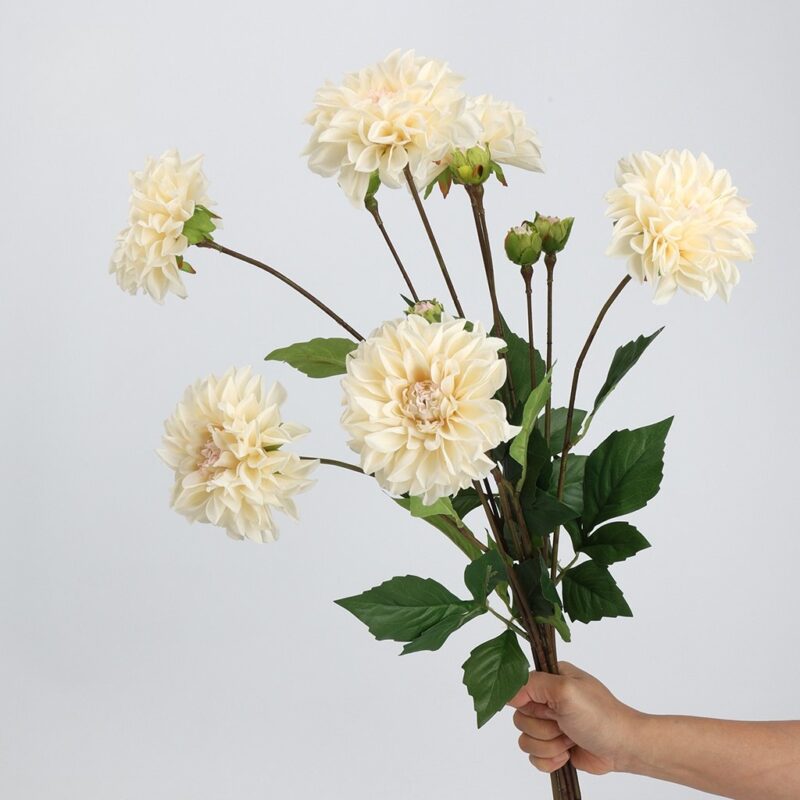
Dahlia is the flower that exposes how an artificial bloom was made, because its whole structure is petal tips and there is nowhere for a shortcut to hide.