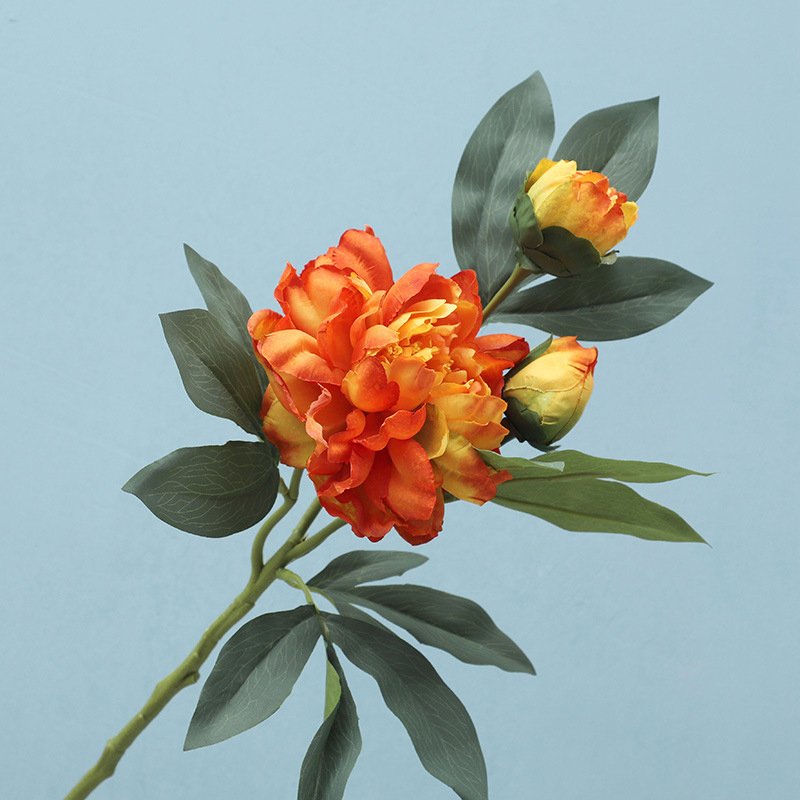
Real peonies have a two to six week season, cost a fortune outside it, and drop their petals within days of opening. That combination is why peonies are one of the most searched-for artificial flowers — and, as it happens, one of the few that reproduce convincingly enough to be worth buying.
This guide covers why faux peonies work so well, what separates a good one from a cheap one, and where the money is worth spending.
Why Faux Peonies Convince and Faux Tulips Do Not
Three things give away an artificial flower: the seam where a petal was cut and formed, the uniformity of the surface, and a geometry that is too symmetrical to be grown.
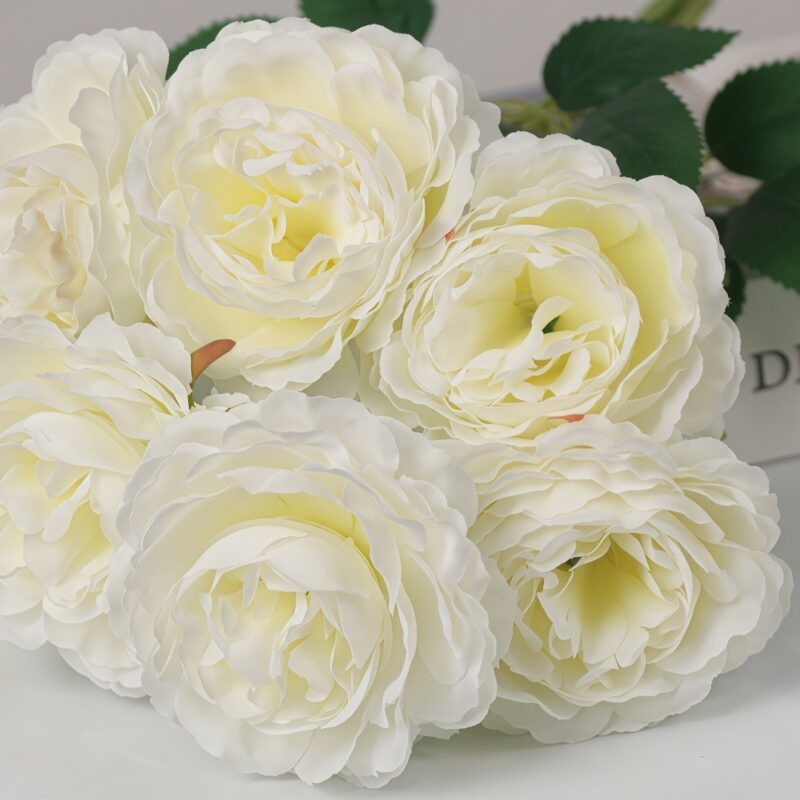
A peony buries all three. A single open bloom carries dozens of overlapping, ruffled petals, so every seam is covered by the petal in front of it and every join disappears into the centre. The eye reads the overall mass, not any individual surface. A tulip, by contrast, offers six large smooth petals with nothing in front of them — every manufacturing seam sits on an uninterrupted surface with nowhere to hide.
That is why a mid-grade faux peony passes inspection at arm’s length while a premium faux tulip does not. The full species ranking is in which flowers look most convincing as faux.
The practical consequence for buyers: peonies are where a mid-grade budget goes furthest, and where paying up for premium material produces the smallest visible return per dollar — with one exception, covered below.
What Separates a Good Faux Peony
Four things separate good faux peonies from cheap ones, in the order they become visible:
Petal count and layering. A convincing open peony carries 40 to 60 petals with the outer ones larger and looser than the centre. Cheap stems use 18 to 24 and make the centre too tight, which reads as a rose rather than a peony.
Graded colour, not flat colour. Real peony petals are paler at the base and deeper at the edge, or the reverse. A single flat dye tone across the whole petal is the clearest tell at close range.
Petal edge finish. Stamped, flat-cut edges catch the light as a hard line. Better stems have a sealed, slightly rolled or wired edge, and the colour changes as it approaches that edge rather than stopping dead.
The ferrule. Grip the head and tug gently at the join with the stem. Movement there is the defect that generates the most complaints at volume, and it is independent of how good the petals are.
Faux peonies are sold in three head states and they are not interchangeable.
Open blooms carry the arrangement. They are also the most expensive per stem, because head size drives material cost more than anything else.
Half-open heads are the most useful per dollar: they read as peonies from any distance and cost less than full open heads.
Buds are filler. A peony arrangement made only of buds looks like a budget decision, but three or four buds among open blooms is what stops an arrangement looking manufactured.
A workable mix for a table arrangement is roughly half open, a third half-open, and the rest buds.
What Real Touch Is Worth on a Peony
Less than most people expect. Across our whole catalogue, real touch runs about 16% above silk at the median per-stem price — not the two or three times that marketing language often implies. A good part of what looks like a real touch premium is actually a head-size premium wearing a disguise; the full dataset is in artificial flower cost per stem.
Where that 16% is worth paying:
Anything held or handed over. A bridal bouquet is inspected by hand at 30cm, and touch is the one test a silk petal cannot pass.
Anything photographed with direct flash. Woven fabric petals reflect light in a uniform sheet; coated surfaces scatter it more like a real petal does.
Where it is not: arch work, backdrops, elevated arrangements, or anything seen beyond arm’s length. There, the same money buys more stems, and density is what makes those pieces look expensive.
Our Peony Range, in Numbers
Our peony line runs to 16 products across 96 variations in 18 distinct colour names. The most common are white (16 variations), pink (14), purple (11), red (10), blue (8) and champagne (8).
Per stem
Peony variations (n=96)
median $2.86, range $0.95–$4.73
All variations in our catalogue (n=1,756)
median $2.46
Two things stand out in that spread. Peonies sit above the catalogue median, which is a head-size effect rather than a quality one. And the range within peonies — roughly five-fold from cheapest to dearest stem — is far wider than the gap between any two materials. Switching material to save money is a weak lever; switching SKU within the same material is a strong one.
Browse Peonies for the range, or US Stock if you need stems domestically this week.
How Many Peony Stems a Vase Needs
Peony heads are large, so the usual stem-count rules bend. Work from the vase opening rather than its height, and use a lower multiplier than you would for a medium bloom: roughly two stems per inch of opening diameter, against three for a rose-sized head.
That gives about 6 to 8 stems for a 3-inch opening and 10 to 12 for a 5-inch. Add greenery at roughly one stem for every two or three blooms — without it, large heads collapse into the centre and the arrangement reads as a bunch rather than an arrangement. The full method, including what to do with wide-mouthed vessels, is in how many stems for a vase.
For background on the cultivated forms that faux peonies are modelled on, the peony overview covers the garden and tree types.
Frequently Asked Questions
Do faux peonies look real?
More convincingly than most artificial flowers, and for a structural reason rather than a manufacturing one. A peony’s dozens of overlapping ruffled petals cover every seam and join, so the eye reads the overall mass instead of any individual surface. Smooth few-petalled flowers such as tulips and calla lilies expose the same seams that a peony hides.
Are real touch peonies worth the extra cost?
At roughly a 16% median premium over silk in our catalogue, they are worth it for anything held, handed over, or photographed with direct flash — bouquets and personal flowers above all. For arch work, backdrops or anything seen beyond arm’s length, the same money buys more stems, and density matters more there than touch.
How much do artificial peonies cost per stem?
In our current range, from $0.95 to $4.73 per stem, with a median of $2.86 across 96 measured variations. That sits above our catalogue-wide median of $2.46, mostly because a large peony head uses more material and ships at lower density — not because peonies are made to a higher standard.
How many faux peony stems do I need for a vase?
About two stems per inch of vase opening diameter, which is lower than the three per inch used for rose-sized heads, because peony blooms are larger. That is roughly 6 to 8 stems for a 3-inch opening and 10 to 12 for a 5-inch, plus greenery at one stem per two or three blooms.
Should I buy open peony blooms or buds?
Both. Open blooms carry the arrangement but cost the most per stem; buds are filler that stops the result looking manufactured. A workable mix for a table arrangement is about half open heads, a third half-open, and the remainder buds.
NB8 Floral supplies wholesale artificial flowers to florists, event professionals, and retailers in the US. Our guides are written from what we see in production, QC, and customer orders.
Hydrangeas are the flower people most often put outside, and the one that most often disappoints them a season later. Both facts have the same cause: the enormous, dense head that makes a hydrangea wo
Most flowers have one kind of petal. An iris has two, doing opposite things, and that is why a material choice that works on a rose can fail on an iris.
Most cost advice about artificial flowers compares materials. We checked our own catalogue — 2,383 price points — and the material is not where the money is.
Dahlia is the flower that exposes how an artificial bloom was made, because its whole structure is petal tips and there is nowhere for a shortcut to hide.
Most advice about artificial flower quality levels stops at a ranking: real touch beats silk, silk beats foam, foam beats plastic. That ranking is broadly right and almost useless, because it never an
You picked the flower before you picked the date, and now the quote has come back at three times what you expected — or the answer is simply that nobody can get it that month. Wedding flowers out of s