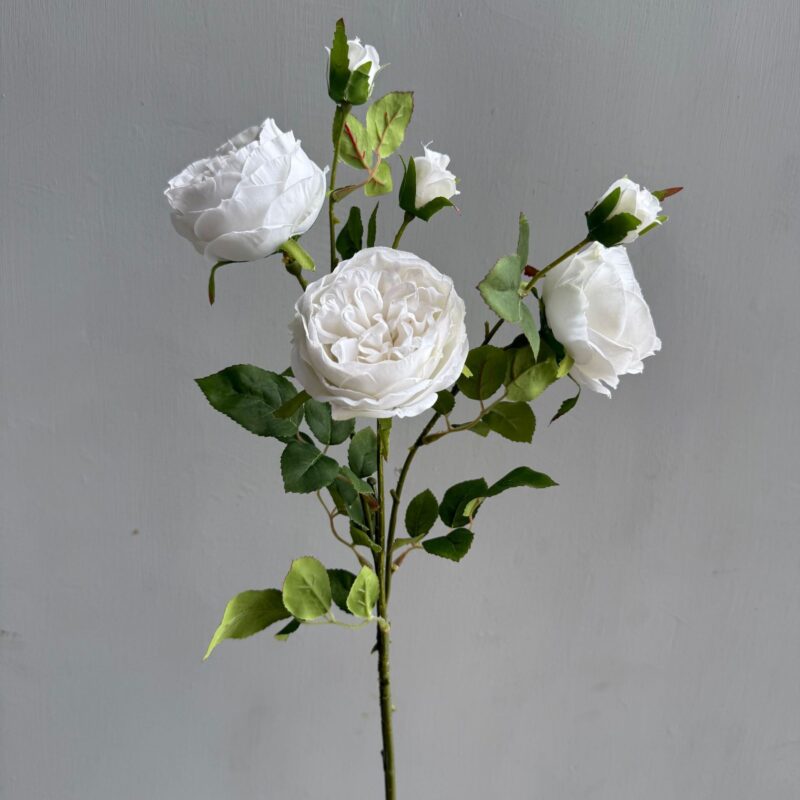
Most advice about artificial flower quality levels stops at a ranking: real touch beats silk, silk beats foam, foam beats plastic. That ranking is broadly right and almost useless, because it never answers the question buyers are actually asking — do I need the expensive one here?
The honest answer is that artificial flower quality levels are not a property of the flower. It is a relationship between the flower and how close the viewer gets.
The Only Variable That Really Decides It: Distance
Sort every piece in your project into three zones. Almost every buying mistake in this category is a piece placed in the wrong zone.
Zone 1 — In the hand (under 0.5m, and touched). Bouquets, boutonnieres, anything a guest picks up. The viewer sees petal edges, stem joins, and colour transitions, and their fingers report texture directly. This is the only zone where premium material reliably justifies its price.
Zone 2 — Table distance (1–3m, seen but not touched). Centerpieces, console arrangements, entry pieces. The viewer reads silhouette, colour, and density. Petal edge finish stops being visible; head shape and arrangement density start doing all the work.
Zone 3 — Across the room or overhead (3m+). Arches, flower walls, suspended installs, shop displays. Nobody can assess material. Density and colour are everything, and money spent on petal realism here is money that cannot be seen.
Matching Artificial Flower Quality Levels to the Zone
Scenario
Zone
Minimum grade that works
Where upgrading is wasted
Bridal bouquet, boutonnieres
1
Real touch / PU — the touch test is unavoidable
—
Table centerpieces
2
Good silk fabric, mixed head sizes
Real touch for every stem
Arch, backdrop, flower wall
3
Mid-grade, bought in volume
Premium stems at 3m — invisible
Photo-forward styling shoots
1–2
Premium for hero blooms only
Premium in the background
Retail or showroom display
2–3
Mid-grade with strong density
Premium on high shelves
Home, daily living space
1–2
Good silk, premium for one focal vase
Premium for filler stems
Seasonal or one-event decor
3
Lowest grade that holds colour
Anything above that
The pattern is simple enough to state in one line: buy grade where hands and lenses go, buy density everywhere else. A dense mid-grade arch outperforms a sparse premium one, every time, at any budget.
Close-Up Bouquets vs. Large Arches: Material by Material
The question most buyers arrive with is narrower than “what grade” — it is usually bouquet or arch, because those are the two ends of the range and they get quoted together. Here is the same logic as a material table.
Material
Close-up bouquet (held, photographed)
Large arch or wall (2 m+)
Real Touch / PU
Yes. Coated surface survives the touch test and flash
Wasted — the coating is invisible at distance
3D-formed silk
Good compromise where budget rules out real touch
Fine, but you are paying for petal depth nobody sees
Woven silk
Workable for non-focal stems in the bouquet
Yes. This is where volume silk belongs
Foam
No — the surface reads as foam in the hand
Good for large filler heads, but check weight
PVC / plastic
No
Yes for greenery and structure that gets knocked
Two specifics worth stating plainly, because they are where money gets wasted in both directions:
An arch does not need premium material, it needs density. The failure mode of an arch is visible gaps, not petal quality. Twelve more mid-grade stems beat six premium ones at 2 metres, every time.
A bouquet cannot be rescued by density. It is held and handed around. If the budget forces one compromise, make it on the arch.
On cost, the trade is smaller than most people expect. Across 2,383 price points in our own catalogue, real touch runs about 16% above silk at the median per stem — not the 200% the reputation suggests. The bigger lever is carton size, which moves per-stem cost by about half. We published the full numbers in artificial flower cost per stem.
The Photography Exception
One case breaks the distance rule. Direct flash and hard studio light reveal sheen, and sheen is the most reliable giveaway of artificial material — more than shape, more than colour.
Woven fabric petals reflect light in a uniform sheet. Coated PU and latex surfaces scatter it more like a real petal does. So if a piece will be photographed with flash, treat it as Zone 1 even if the camera is six feet away.
Two practical consequences: avoid hard direct flash on fabric-petal arrangements, and if a shoot demands flash, put the coated material where the light hits hardest.
Four Tests That Take a Minute on a Sample
Before you commit to any grade, run these on one stem. They will tell you more than any product photo.
Backlight it. Hold the bloom against a window. Real petals are translucent and unevenly so. Cheap petals go flat and opaque; good ones show graded translucency toward the edge.
Squeeze the head and let go. Good material springs back with a soft recovery. Stiff material creases and keeps the crease — which is also how it will look after shipping.
Look at the petal edge. Cut-and-pressed edges look stamped. Better stems have a sealed, slightly rolled, or wired edge, and the colour changes as it approaches the edge instead of stopping flat.
Check the ferrule. Where the head meets the stem, give a firm tug. A head that shifts is a defect that will show up at scale, regardless of how good the petals are.
Overspending on Zone 3. A premium flower wall is the single most common way to burn a decor budget on something no guest can evaluate. The same money spent on more mid-grade stems produces a visibly better wall, because the failure mode of a wall is always gaps, never petal quality.
Underspending on Zone 1. The bouquet is in every photograph, held, and handed around. It is the one piece where a guest’s fingers will make a judgment your product photos cannot override. If the budget forces a compromise, compromise everywhere else first.
A Working Allocation
Once you stop treating artificial flower quality levels as a single ranking, the allocation gets easy. For a typical event or styling project, a defensible split is: premium for the handful of Zone 1 pieces, mid-grade in volume for Zone 2, and the lowest grade that holds its colour for Zone 3 — with the savings from Zone 3 redirected into buying more of it.
That allocation usually produces a better-looking result than spending the same total evenly, and it is the reason “what grade should I buy” has no single answer.
Browse Real Touch Flowers for Zone 1 pieces, Best Sellers for Zone 2 volume, and Greenery for the density that makes Zone 3 work. If you want to check a grade yourself before committing, order a small sample set and run the four tests above.
For background on why coated and woven surfaces reflect light differently, the specular reflection overview explains the sheen effect in plain terms.
FAQ
Do you always need the most realistic grade?
No. Quality is not a property of the flower; it is a relationship between the flower and how close the viewer gets. Sort every piece into three zones: in the hand, under half a metre and touched; table distance at one to three metres; and across the room or overhead at three metres and beyond. Premium material reliably justifies its price only in the first zone. At three metres nobody can assess material at all, so money spent on petal realism there is money that cannot be seen.
What grade does an arch or flower wall need?
Mid-grade, bought in volume. The failure mode of an arch is visible gaps, not petal quality, and twelve more mid-grade stems beat six premium ones at two metres every time. An arch does not need premium material, it needs density. A bouquet is the opposite case: it is held and handed around, so it cannot be rescued by density. If the budget forces one compromise, make it on the arch.
When does the distance rule break down?
Under direct flash and hard studio light. Sheen is the most reliable giveaway of artificial material, more than shape and more than colour, and woven fabric petals reflect light in a uniform sheet while coated PU and latex surfaces scatter it more like a real petal does. So if a piece will be photographed with flash, treat it as a close-up piece even if the camera is six feet away: avoid hard direct flash on fabric-petal arrangements, and put the coated material where the light hits hardest.
How much more does real touch actually cost than silk?
About 16 percent at the median per stem, measured across 2,383 price points in our own catalogue, not the 200 percent the reputation suggests. The bigger lever is carton size, which moves per-stem cost by roughly half. The full numbers are published in our artificial flower cost per stem analysis.
What can you test on a single sample stem?
Four things, in about a minute. Backlight the bloom against a window: good petals show graded translucency toward the edge while cheap ones go flat and opaque. Squeeze the head and let go, because good material springs back with a soft recovery while stiff material keeps the crease, which is also how it will look after shipping. Look at the petal edge, since cut-and-pressed edges look stamped while better stems have a sealed, slightly rolled or wired edge. And give the ferrule a firm tug where the head meets the stem, because a head that shifts is a defect that will show up at scale regardless of how good the petals are.
Yang Yue is the founder of NB8 Floral in Yiwu, Zhejiang, working with US florists and event planners who source artificial flowers. The per-stem figures in this analysis were compiled from the company's own published catalogue, with the method and its limits set out in the article above.
NB8 Floral supplies wholesale artificial flowers to florists, event professionals, and retailers in the US. Our guides are written from what we see in production, QC, and customer orders.
Almost every guide to the most realistic artificial flowers answers the question with a material: buy real touch, buy silicone, avoid plastic. That advice is not wrong, and it is not the main effect.
Most cost advice about artificial flowers compares materials. We checked our own catalogue — 2,383 price points — and the material is not where the money is.
Ask a supplier how long their flowers last outdoors and you will almost always get the same two answers: "they are UV resistant" and "avoid direct sunlight." Neither is a number, and neither tells you